How it looks in use
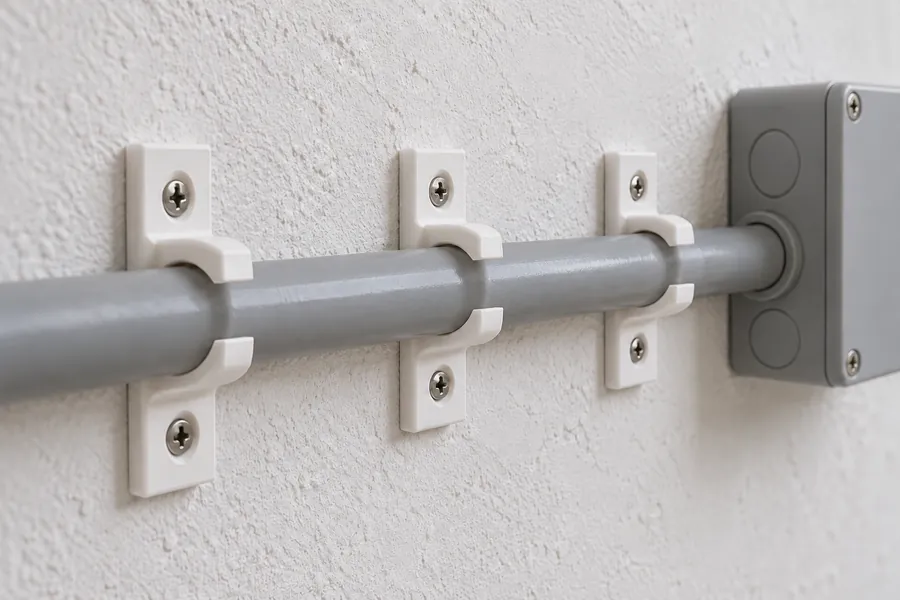
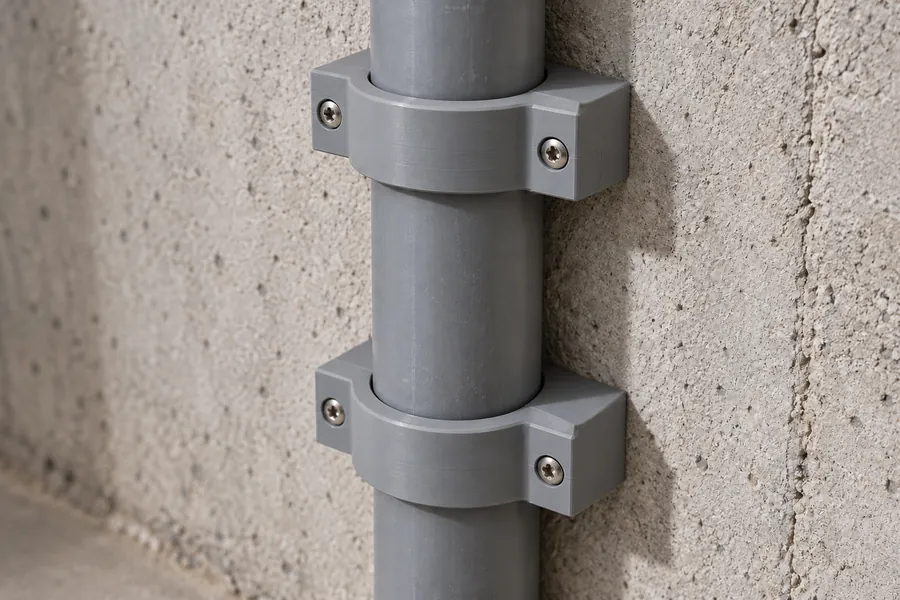
AI-generated example images in a small and a large size, not photos of prints.
How the generator works
First measure the outside diameter of the pipe or cable, ideally with a caliper. For a bundle of cables, use the diameter of the whole bundle. Then choose the type. A clip is screwed or stuck to the wall, and you simply press the pipe into it afterwards. A clamp has two parts: the lower part sits on the wall, the upper part goes over the pipe, and the same screws hold both parts and the whole clamp on the wall.
The fit sets how firmly the pipe is held. "Snug" makes the opening 0.3 mm larger than the pipe, "Loose" 1 mm larger so the pipe can still slide. "Tight" makes it 0.5 mm smaller so the holder grips the pipe. With the number of pipes you can place several pipes or cables side by side in one holder.
In "Simple" mode the generator chooses wall thickness, width, tabs and countersink to suit the pipe and the screw. In "Pro" mode you set these values yourself, as well as the clearance in millimetres, the opening of the clip and the gap between the two parts of the clamp. Your input is kept when you switch modes.
Screw-down clamp
The clamp leaves a 1 mm gap between the lower and the upper part. Tightening the screws closes it and the clamp grips the pipe. The screws go through both tabs into the wall, so they are longer than for the clip. The generator shows the matching length below the preview.
How the clamp is printed
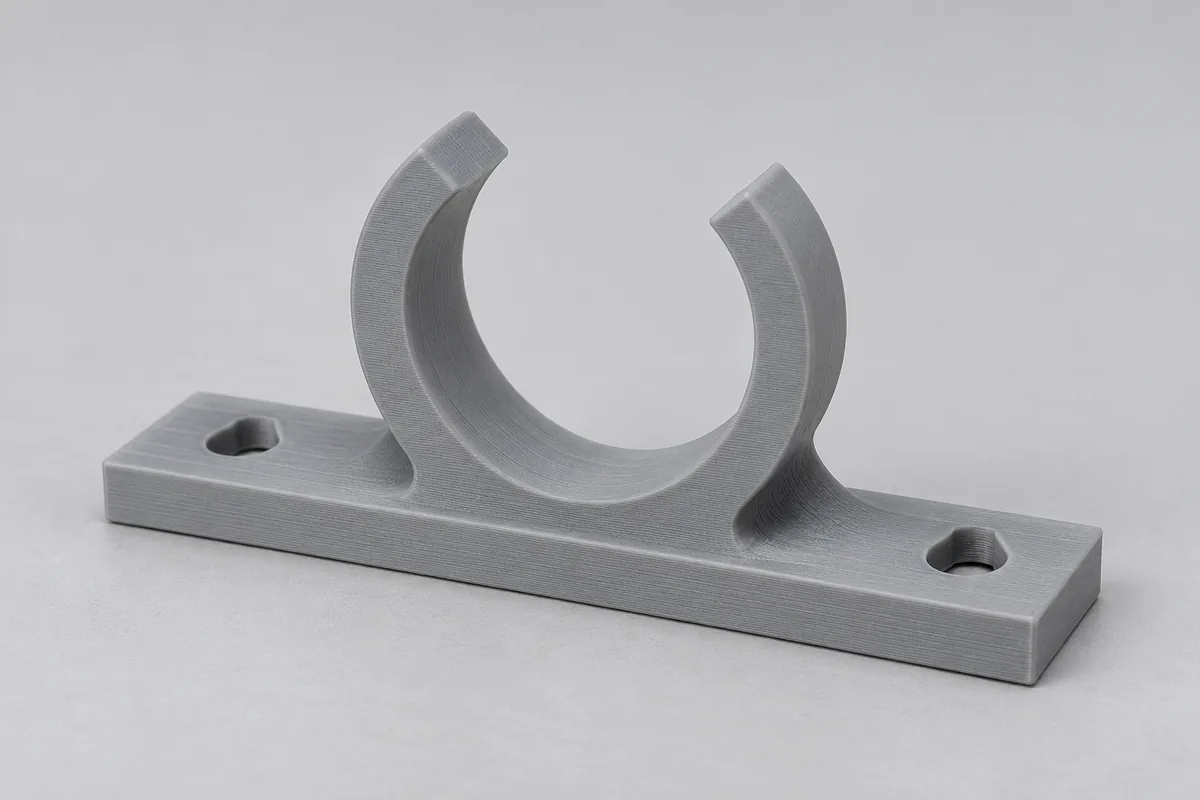
The STL file is already oriented for printing: with the front face on the print bed, as shown in the drawing. Every printed layer is then a complete ring. The clip flexes along the layers when you snap a pipe in and does not break as easily along a layer line. For the clamp, both parts sit next to each other in one file.
In this orientation the screw holes are horizontal. They get a small 45° roof at the top so that they print cleanly without supports. Below the download button the generator shows whether supports are needed.
Screws and mounting
The screws sit in tabs to the left and right of the ring. The tabs are long enough to leave at least 1.2 mm of material between the countersink and the ring. For wood, wall plugs and chipboard, use a wood or chipboard screw with a countersunk head. The generator works out the screw length from the thickness under the head plus five times the screw diameter, rounded up to a common length.
With large pipes the ring stands close to the screw head. The generator therefore checks whether a small or large screwdriver and a cordless drill can reach the head in a straight line. "Show assembly" plays this as an animation in the preview.
How strong the clamp is
The generator does not show a load for pipe clamps. How well a clip holds depends heavily on the fit, the material and the print. The weight of a pipe is carried mainly by the screws and wall plugs, which the generator does not calculate. For heavy or hot pipes, use metal clamps instead, and do not use printed clamps for safety-critical lines.
Frequently asked questions
Which material should I use for a clip?
PETG is the default because it is tougher than PLA and less likely to break when you snap a pipe in. PLA works too, but then choose "Snug" rather than "Tight". PLA is not suitable for pipes that get warm, such as heating pipes: according to Prusa it softens from about 55 °C. Use ASA or PC Blend there.
The pipe will not snap in. What can I do?
Choose a looser fit or increase the opening in "Pro" mode. An opening of 80 % means the gap at the top is 80 % as wide as the pipe. The larger the value, the easier the pipe goes in and the less firmly the clip holds it.
Does the clip hold with adhesive tape?
On smooth, clean surfaces such as tiles, glass or painted wood, double-sided mounting tape usually holds well. Below the preview you see the size of the adhesive area, so you can cut the tape to fit. On textured wallpaper, plaster or dusty surfaces tape holds poorly; use screws there.
How do I measure a cable or pipe correctly?
Measure in several places and take the largest value. Many pipes have a standard outside diameter, for example 15, 18 or 22 mm for copper pipe. For soft cables "Snug" is a good choice, because the sheath compresses easily.
Can I save or share my settings?
Yes. All settings are stored in the page address. Use the "Copy link" button and save the link as a bookmark or send it on. Anyone who opens the link sees exactly your clamp.
The generator runs entirely in your browser. Your dimensions are not transmitted. When you download a file or copy the link, the page counts anonymously which generator, mode, material and screw type were used.