The delivery list becomes a finished Shopware product: matched against the stock, missing details researched, images prepared. Nothing is created until a person approves.
A single item from a delivery note, seven stations long. The left side shows what happens at each point; the right side, what the data looks like afterwards. Newly added content is copper-coloured, discarded content struck through.
Brand, numbers, sizes, quantities and prices in this demonstration are made up. “Steinlauf” does not exist, the number starts with a sample prefix, and the amounts are placeholders. The process, on the other hand, is the real one.
Four sources, one way in, one way out – and three points at which something is held back. The locks are the actual design: no write operation runs without prior approval.
The diagram is wide – on a phone it can be swiped sideways.
One costs money, one changes the shop, one does neither. Combined in a single button, they could no longer be undone individually.
The delivery list is checked line by line against the existing stock: new, partly present or long since in the shop.
Only for items that are genuinely new, and only after selection. The estimated amount is shown next to the button before anyone presses it.
In batches, throttled, with a safety prompt. Every product is created inactive and with zero stock.
What is not shown here. The tool works on the real stock of a real shop. This page therefore contains no product numbers, prices, supplier data or images from it. The demonstration above runs on invented data.
Everything is operated in the browser, on the computer in the shop. The process is laid out as a row at the top: scan, incoming goods, research, upload – it is always visible where one stands and what the next step costs.
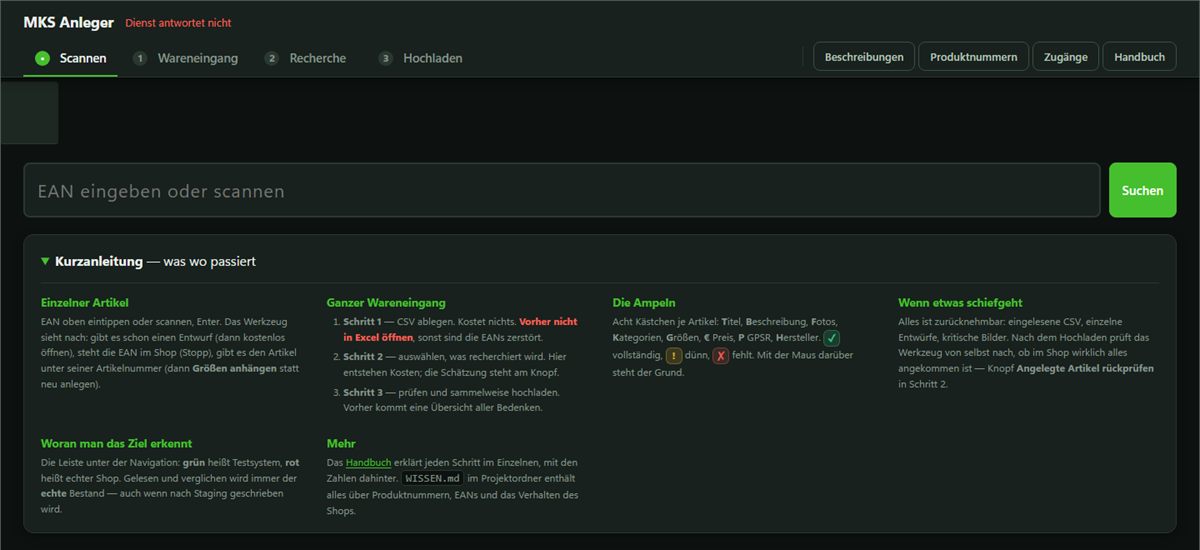
| Page | Purpose | Affects |
|---|---|---|
| Create | The main route: incoming goods, research, review list, upload | reads the live shop, writes to the test system |
| Descriptions | Review existing texts and plan a rewrite | reads the live shop, writes only locally |
| Product numbers | Review numbers, assess them and note down the rule behind them | reads the live shop, writes only locally |
| Access | The brands’ B2B portals: access, conditions, copyright notice | local only |
| Manual | Operation, step by step | – |
The table has three columns – on a phone it can be swiped sideways.
Target system indicator. The tool can write to two systems. The header therefore shows at all times which one is currently being worked on. The indication comes from the connection itself – not from a label that someone might forget to switch over.
From the delivery line to the post-check in the shop. The right-hand column shows whether a station costs money and whether it changes the shop.
| Station | What happens | Consequences |
|---|---|---|
| 00 · Catalogue copy | The stock is fetched read-only as a local copy. | read-only |
| 01 · Delivery list | Old character encoding, messages before the header row, corrupted identifiers – detected rather than guessed. | changes nothing |
| 02 · Matching | Multi-stage duplicate check. Result: new, partly present or present. | changes nothing |
| 03 · Categorising | Categories, size axis and properties from the most similar existing products. Without a language model. | changes nothing |
| 04 · Research | Language model with web search, only for selected products. Limits per product and per day stop the run. | costs money |
| 05 · Proposal | Title, description, product number and mandatory details in the house style. | changes nothing |
| 06 · Review | Traffic light per field, concerns at three levels. | changes nothing |
| 07 · Approval | A person sets the price and approves. Without a price, nothing is created. | Lock |
| 08 · Create | One call creates the parent product, sizes, categories and properties. Inactive, zero stock. | changes the shop |
| 09 · Post-check | Every product is read afresh and compared against the proposal. | read-only |
| 10 · Rollback | Files, drafts and jobs can be discarded individually. | reversible |
Anyone who assigns numbers themselves usually calculates the check digit correctly. What is checked, therefore, is the allocation range: ranges reserved for in-house use must not enter the shop as an official identifier.
The question “where does a softshell jacket belong?” has long been answered in the stock – hundreds of times, by people who know the shop. Having a language model choose from several hundred categories costs money, takes time, and at best justifies itself with “because it fits”. Matching against the most similar existing products costs nothing and justifies itself: because 214 other softshell jackets are there.
Three separate routes, distinguished by how strongly they intervene.
| Route | What it does | When |
|---|---|---|
| Standard | Cropping, squaring, white background, uniform edge margin. Purely computational, without AI. | on every image |
| Deep check | Five methods search for markings and measure image defects. Changes nothing. | in the review screen |
| Image editing | Manual re-cutting when the automation reaches its limit. | on request |
It looks for copyright notices in the metadata fields, for lettering, for faint overlays, for patterns in the least significant bit and for repeating tiles. All algorithmic, without any outside call. Each of the five searches also states what it cannot do.
Every find gets a frame, a number and – for invisible finds – an evidence image. Then the tool asks, and without an answer nothing happens. A find classified as third-party blocks the image. Only what a person has confirmed as their own mark is removed. A third-party photo does not become one’s own through editing, and a removed copyright notice makes the situation worse.
Measurement is done on a test bench with self-generated test images. Half of the cases check whether the search can stay silent – a detector that goes off on every image is as useless as one that never goes off. This uncovered five real bugs, including a search that mistook the ventilation slots of a helmet for a pattern.
Instead of a fixed brightness threshold, a model of the background is fitted to the edge pixels – a slightly tilted plane with fall-off towards the centre. This covers lighting gradients and vignetting. The tolerance comes from the spread of these edge pixels: a clean light tent gets a tighter one than a wooden table. White on white without contrast is reported as unsuitable rather than guessed.
Read off the existing stock, not invented. Their content is business know-how and is not given here – what is described is what they decide.
| Rule set | What it decides |
|---|---|
| Number structure | What the product number of a new model has to look like – and when, by exception, it differs. |
| Duplicate check | Whether the product already exists. Several stages, from “proof” to “hint”. |
| Categorisation | Categories, size axis and properties – from the most similar existing products. |
| Number authenticity | Whether a number is an assigned identifier or invented in-house. |
| House style | Structure of title and description, what belongs in them and what never does. |
| Image source per brand | Which dealer access the material comes from and which copyright notice is carried along. |
| Cost limits | How much a research run may cost per product and per day. |
Much of this came about during building, because a closer look revealed that something was missing.
Built in August 2026, component by component. The core works.
| Surveying the stock | Done |
| Reading, mirroring, checking | Done |
| Categorising and proposal | Done |
| Write path and rollback | Done, on the test system |
| Images from the dealer portals | Done |
| Image check and manual editing | Done |
| Plausibility and title review | In progress |
| From the test system to the live shop | Open – it remains to be clarified which system holds which product data |
The tool replaces no one; it takes over the typing. The price is never set automatically. It runs on one computer, without a network service, and accesses the shop server read-only. Image material comes from the manufacturers’ B2B portals or from in-house photography – an edited image is not free of rights. The tool is shown with the consent of Muskelkater Sport Köln and without data from ongoing operations.
Questions about how it is built, the decisions behind it or its transferability to a different case.