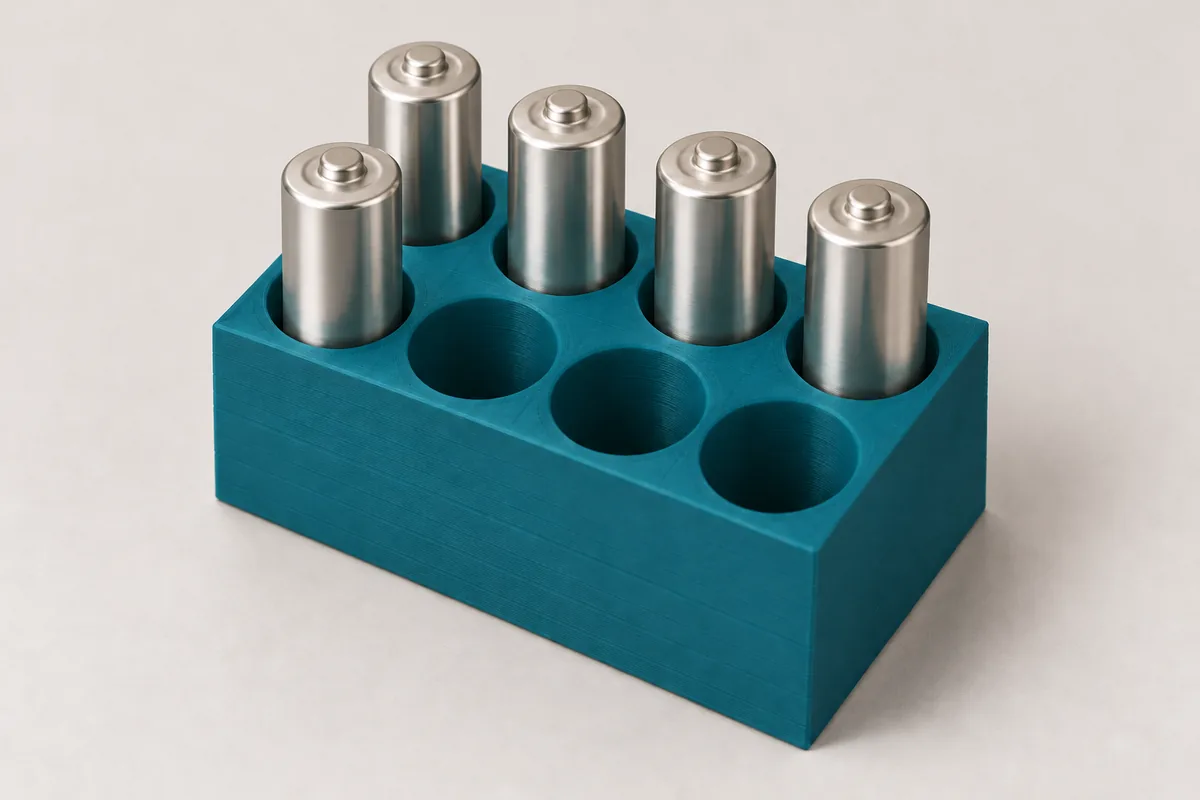
Free of charge and without warranty. How well the cells sit depends on your printer and the material. Check every printed part yourself before you use it. The terms of use apply.
How it looks in use
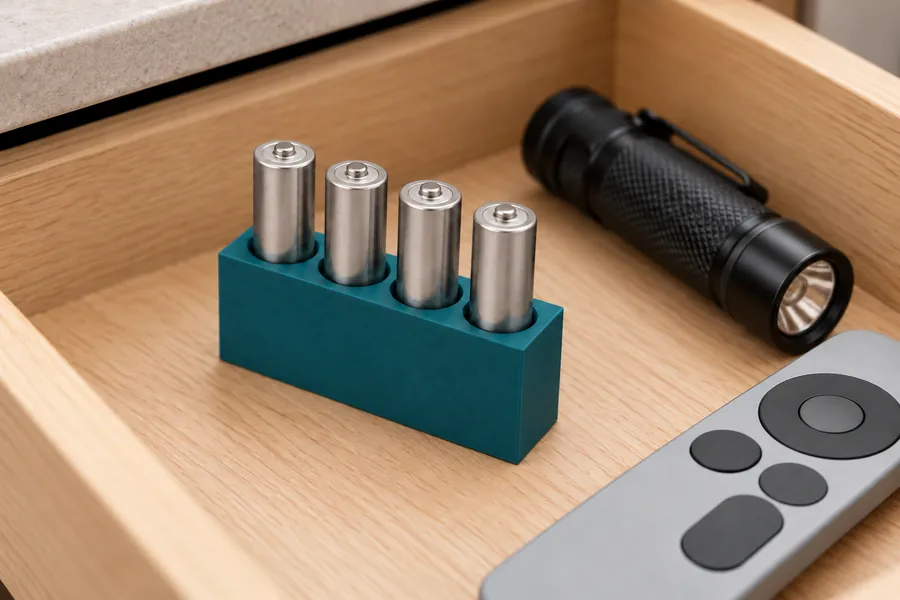
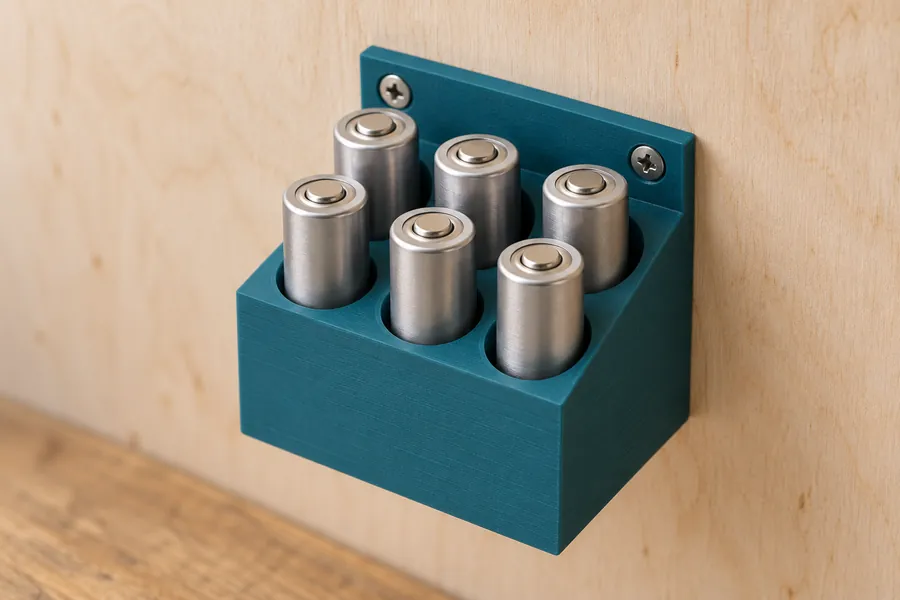
AI-generated example images in a small and a large size, not photos of prints.
How the generator works
First choose the cell type, for example AA for the common household batteries. The generator knows the sizes of all cells on offer and makes the slots a little larger, so the cells drop in easily. Rows and columns set how many slots the holder has. The cells stand upright and stick out at the top, so you can grip them easily.
The generator sets the slot depth to about half the height of the cell. You can also enter it yourself. Under "Placement" you choose whether the holder stands freely in a drawer or on a shelf or is screwed to the wall.
In "Simple" mode the clearance, dividers, base and chamfer are fixed. In "Pro" mode you change these values yourself and choose the screw in more detail. Your input is kept when you switch modes.
Round cells, 9 V blocks and coin cells
For round cells such as AA, AAA, C, D and 18650, each slot is round. The 9 V block stands in a rectangular slot with its terminals at the top. CR2032 coin cells stand on edge in narrow slots, like coins in a coin holder. This way you can take out each cell on its own.
Holder for the wall
For wall mounting, the holder has a back plate that rises above the slots. It has one or two holes for countersunk screws. Screw the holder to the wall before you put in the cells. Below the preview you can see whether a screwdriver or cordless drill reaches the screws.
How the holder is printed
The STL file is already oriented the way it should be printed: standing, with the slots facing up. The slot walls are vertical, and the edges have a 45° chamfer. The holes in the back plate have a small point at the top so that they come out cleanly round without supports. You do not need support material.
Where the cell sizes come from
The sizes of AA, AAA, C, D, 9 V and CR2032 cells are set out in the IEC 60086-2 standard. The generator uses the largest sizes allowed there, which also appear in the manufacturers' data sheets. An AA cell, for example, is at most 14.5 mm thick and 50.5 mm tall. There is no such standard for 18650 cells. For these, the generator uses 18.55 mm diameter and 65.25 mm height from a manufacturer's data sheet. Cells with a protection circuit are often a few millimetres longer. They still fit and simply stick out further.
Safety with coin cells and batteries
Coin cells are dangerous for small children if swallowed. An open holder does not protect against this. Keep coin cells out of the reach of children. Store batteries such as 18650 cells and 9 V blocks so that the terminals do not touch each other and no metal can reach them, and keep them away from anything flammable. The generator gives no load values, because the holder only carries the small weight of the cells.
Frequently asked questions
The cells stick in the slots. What can I do?
Increase the clearance in "Pro" mode, for example from 0.8 to 1.2 mm. Printed holes often come out a little smaller than in the model, especially in the first layer. With more clearance the cells drop in more easily.
How many slots fit on my printer?
The generator allows up to 10 rows and 10 columns, as long as the holder fits on a 220 mm print bed. For AA cells that is 10 by 10 slots, for D cells about 5 by 5. If the holder is too large, a note appears and you reduce the number of slots.
Which material should I use?
PLA is perfectly fine for a battery holder in the house and is the easiest to print. If the holder sits somewhere warm, such as a garage under the roof, PETG is the better choice. According to Prusa, PLA softens from about 55 °C and PETG only from about 68 °C.
Can I save or share my settings?
Yes. All settings are stored in the page address. Use the "Copy link" button and save the link as a bookmark or send it on. Anyone who opens the link sees exactly your holder.
The generator runs entirely in your browser. Your dimensions are not transmitted. When you download a file or copy the link, the page counts anonymously which generator, mode, material and screw type were used.