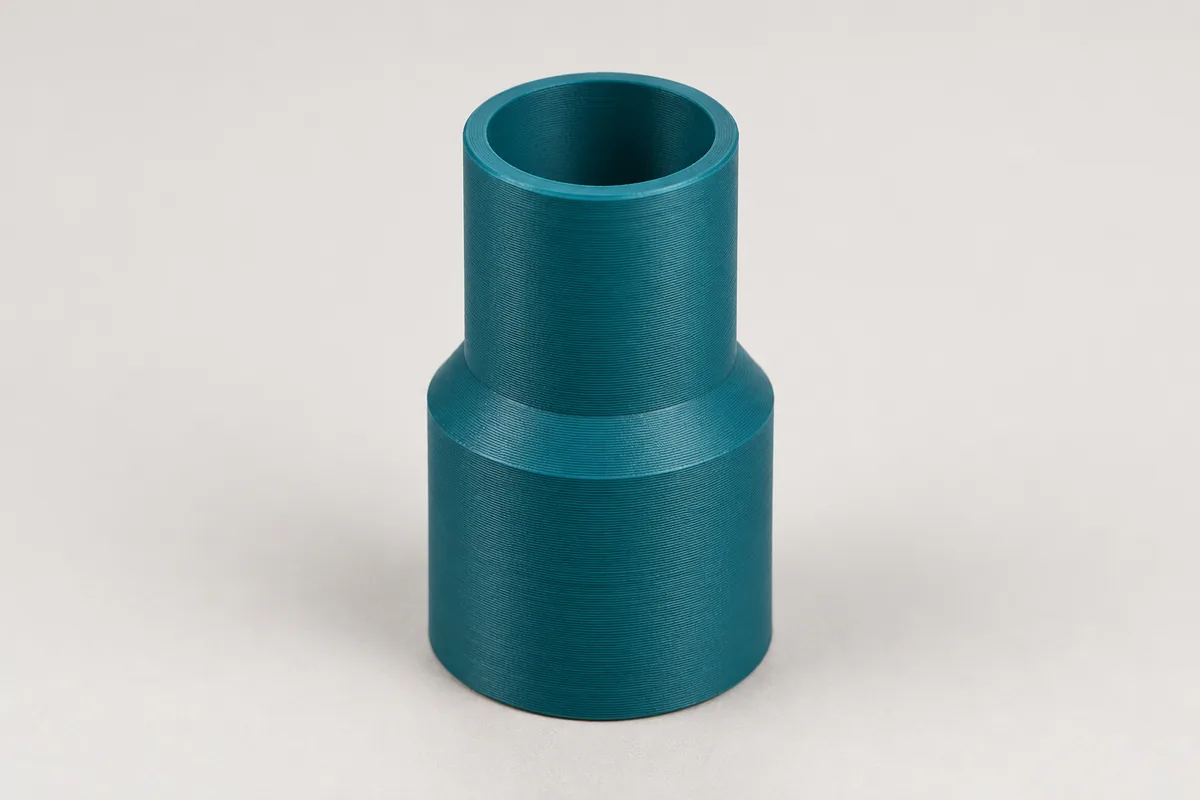
Free of charge and without warranty. How well an adapter fits and holds depends on your printer, the material and your devices. Check every printed part yourself before you use it. The terms of use apply.
How it looks in use
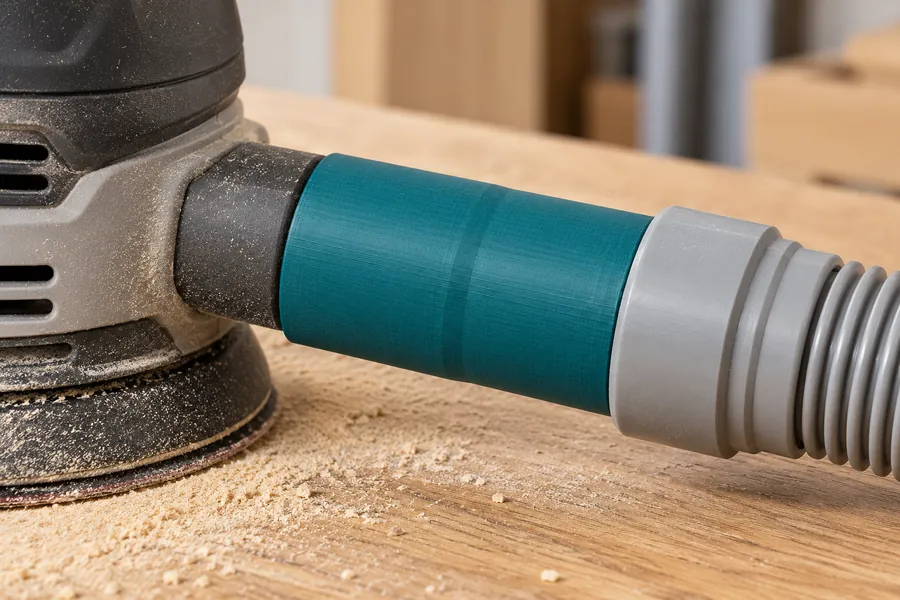
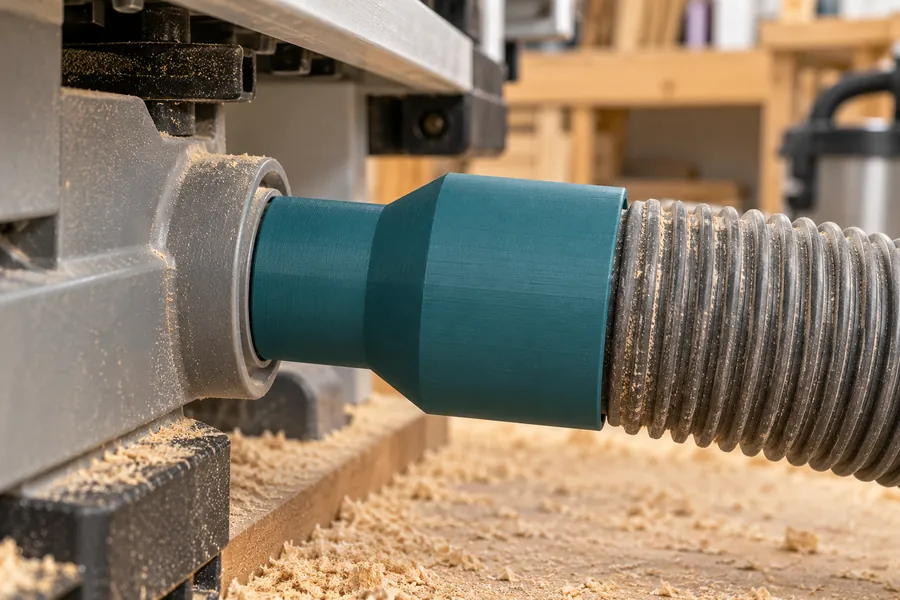
AI-generated example images in a small and a large size, not photos of prints.
How the generator works
An adapter has two ends, A and B. For each end, measure the mating part, ideally with a calliper. If the adapter is to slide over a spigot, measure its outer diameter and choose "Socket". If the adapter is to go into a hose or an opening, measure its inner diameter and choose "Spigot". Common sizes are in the list; with "Custom" you enter any diameter yourself.
The fit sets how firmly the adapter sits. "Snug" gives 0.3 mm of clearance on the diameter, "Tight" 0.1 mm and "Loose" 0.6 mm. Between the two ends there is a tapered transition. Its slope lets you print the adapter without support material.
In "Simple" mode the generator sets the insertion length, wall thickness, taper and transition to suit the diameters. In "Pro" mode you set these values yourself, as well as the tolerance in millimetres and the chamfer at the openings. Your input is kept when you switch modes.
Socket or spigot
A socket surrounds the mating part. Its inner diameter is larger than the measured size by the tolerance. A spigot goes inside the mating part. Its outer diameter is smaller by the tolerance. Both ends can be of the same type, for example two sockets to join two spigots.
Taper for a firm fit
Many connections on vacuums and tools are slightly tapered. That is why each end has a taper of 1° per side in "Simple" mode. A spigot gets slightly thinner towards its opening, a socket slightly wider. The adapter is easy to start and clamps as you push it further on. The size with tolerance applies at the middle of the insertion length. In "Pro" mode you choose a taper between 0° (straight) and 3°.
Common connection sizes
The list contains diameters that are common on vacuums, hoses and power tools: 27, 32, 35, 36, 38, 42, 58 and 100 mm. Tubes of household vacuums are often 32 or 35 mm, workshop vacuums and their hoses often 36 or 58 mm, and dust extractors for woodworking often 100 mm. The exact sizes vary between manufacturers. Always measure your mating part and choose "Custom" if it differs.
How the adapter is printed
The STL file is already oriented the way it should be printed: standing, with the thicker end on the print bed. The walls are almost vertical, and the transition slopes at no more than 45°. You do not need support material.
The chamfers at the openings make the adapter easier to push on. On the print bed they also make up for the first layer, which often comes out a little wider. For airtight walls, use at least three perimeters in your slicer.
Limits of the adapter
The generator does not show a load for adapters. An adapter carries no weight; above all it has to be airtight and hold when someone pulls on the hose. How well it holds depends on your mating part, the tolerance and the printer. Check the fit on your device and adjust the tolerance if needed. Near hot motors or exhaust air, PETG or ASA is a better choice than PLA.
Frequently asked questions
The adapter is too tight or too loose. What can I do?
Choose a different fit or change the tolerance in "Pro" mode in steps of 0.1 mm. A larger value makes a socket wider and a spigot thinner. For a large adapter, first print a short test piece with a small insertion length; that saves time and material.
Will the adapter fit my device?
That depends only on your measurements. The list in the form names common diameters only and is not a list of particular devices. Measure the connection on your device where the adapter will sit. On tapered connections, measure at the middle of the length the adapter is meant to cover.
Which material should I use?
PETG is tough and copes with knocks and some heat, according to Prusa up to about 68 °C. That is why it is the default. PLA is easier to print but softens from about 55 °C. For connections to warm exhaust air, ASA is a good choice.
Are there adapters with a bend?
Not yet. The generator creates straight adapters because they print reliably without support material. For a change of direction you can combine an adapter with a piece of hose.
Can I save or share my settings?
Yes. All settings are stored in the page address. Use the "Copy link" button and save the link as a bookmark or send it on. Anyone who opens the link sees exactly your adapter.
The generator runs entirely in your browser. Your dimensions are not transmitted. When you download a file or copy the link, the page counts anonymously which generator, mode and material were used.